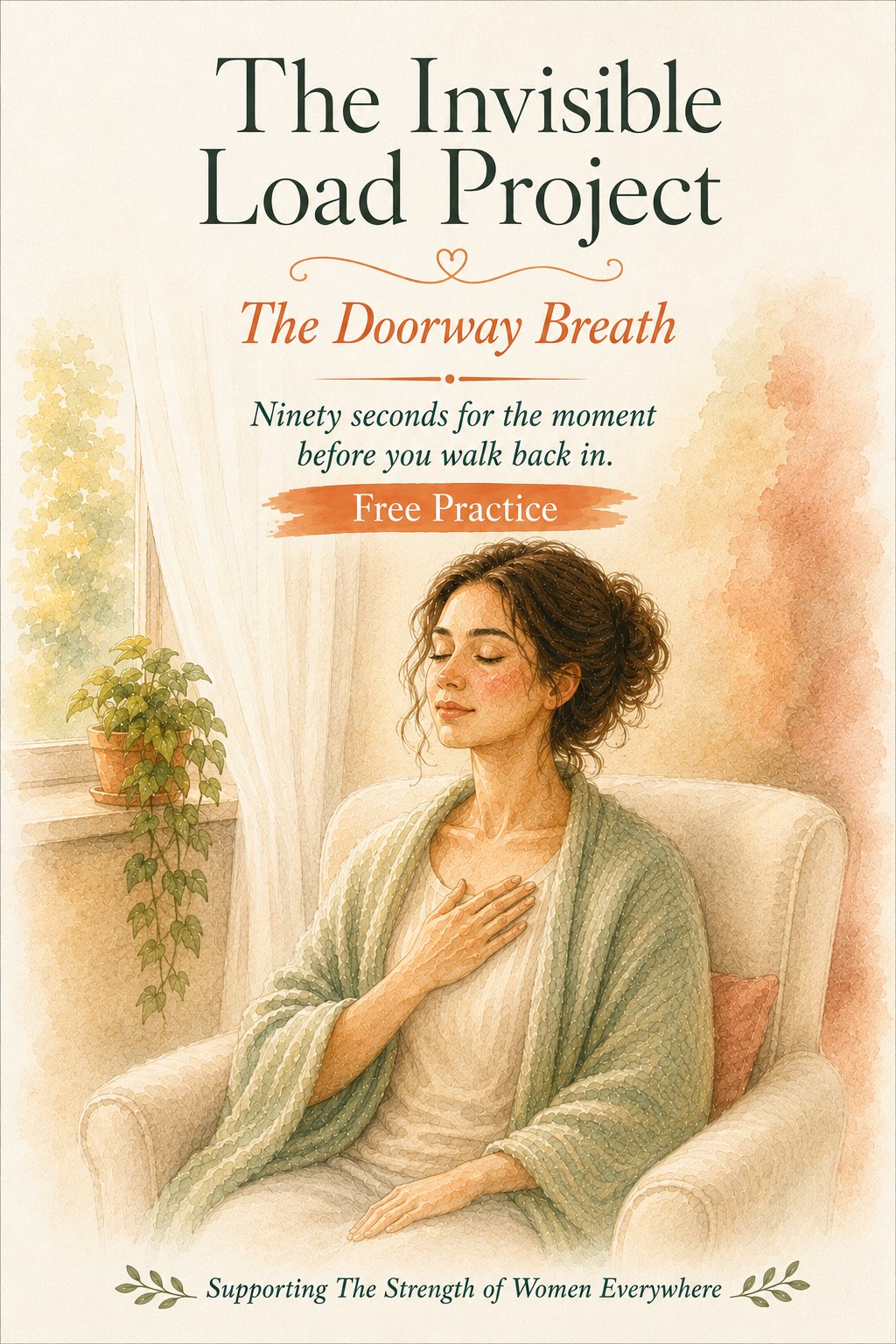
Ninety seconds for the moment before you walk back in. A free illustrated practice for the woman who is holding everything together — three steps, nothing to buy.
Ninety seconds for the moment before you walk back in. A free illustrated practice for the woman who is holding everything together — three steps, nothing to buy.
You're in the car in the driveway with the engine already off. You're in the hallway outside a room where someone is calling your name. You're at the bathroom sink with the door locked, and you have maybe a minute.
You're not falling apart — that's the part nobody sees. You are functioning, beautifully and relentlessly, on a nervous system that hasn't been given one moment to land since you opened your eyes this morning.
Nobody schedules that moment for you. So the body stays braced, and bracing held long enough stops feeling like bracing and starts feeling like your personality.
“Just take a deep breath” is well-meant, and it's backwards.
A big inhale is an accelerator — it lifts your heart rate slightly, because that's its job. So when you're already wound tight and someone tells you to pull in more air, your chest often gets tighter, not looser. Then you decide you're bad at breathing, on top of everything else you're carrying.
The exhale is the brake. When your out-breath is longer than your in-breath, the vagus nerve reads it as a signal that you're safe enough to slow down, and your heart rate follows within a few cycles. That isn't a mindset — it's a mechanism you can operate on purpose.
Let the exhale be longer
than the inhale.
This is also the most studied part. In a randomized controlled trial published in Cell Reports Medicine in 2023, Stanford researchers compared three breathing patterns against mindfulness meditation over one month. The exhale-focused pattern — longer out-breaths — produced the greatest improvement in mood and the largest drop in breathing rate, in five minutes a day.
Not magic, and not a cure. But slow, exhale-led breathing is one of the few things you can do in ninety seconds, anywhere, that changes your physiology rather than just your intentions.
Lengthening the exhale shifts you toward the parasympathetic side — heart rate eases, breathing rate drops, and the body stops preparing for something.
Counting a breath occupies the same attention that rumination runs on. It's very hard to catastrophize and track an out-breath at the same time.
Ninety seconds between the trigger and the response is often the whole difference between reacting and choosing — especially with the people you love most.
Used in bed, extended-exhale breathing shortens the gap between lying down and letting go — useful when the day's list arrives the moment your head hits the pillow.
No cushion, no quiet house, no free hour, no one's cooperation. You can do it standing up, in the dark, holding a baby, with your eyes open.
Once your body knows it, it's available for the rest of your life at no cost and with no app. That's rare in wellness.
Find where your body is already touching something — the floor, a doorframe, the edge of the sink. Let it take some of your weight. You've been holding yourself up all day.
Through your nose, unhurried. Don't fill all the way — about three-quarters is plenty. Let your belly move before your chest does.
Through your mouth, soft, like fogging a window close to your face. Slow, never forceful. Let it end on its own.
Six times. That's ninety seconds. No breath holds — there's no pause at the top and none at the bottom. If counting is one more thing to manage, drop the numbers entirely and just make the out-breath longer than the in-breath. It still works.
Thirteen pages: the practice, why it works, a ten-second version for the sharper moments, what to do when it doesn't work the first time, and four reflection pages for when you have a pen. Print it, or keep it on your phone.
You go to a page where you enter your email, and the practice is delivered to your inbox. Nothing to buy. No catch. It's free.
A note on what this is. The Doorway Breath is a coaching and self-awareness tool. It is not medical treatment, psychotherapy, or a substitute for care from your doctor, midwife, therapist, or pelvic health physical therapist. If you have a heart or lung condition, or you're being treated for a panic or anxiety disorder, check with your clinician before adding a breathing practice.
If you need someone now. National Maternal Mental Health Hotline — call or text 1-833-TLC-MAMA (1-833-852-6262), free and confidential, 24/7. Postpartum Support International HelpLine — call or text 1-800-944-4773 (not a crisis line). If you are in crisis or having thoughts of harming yourself or your baby, call or text 988, or call 911.